



Claim:
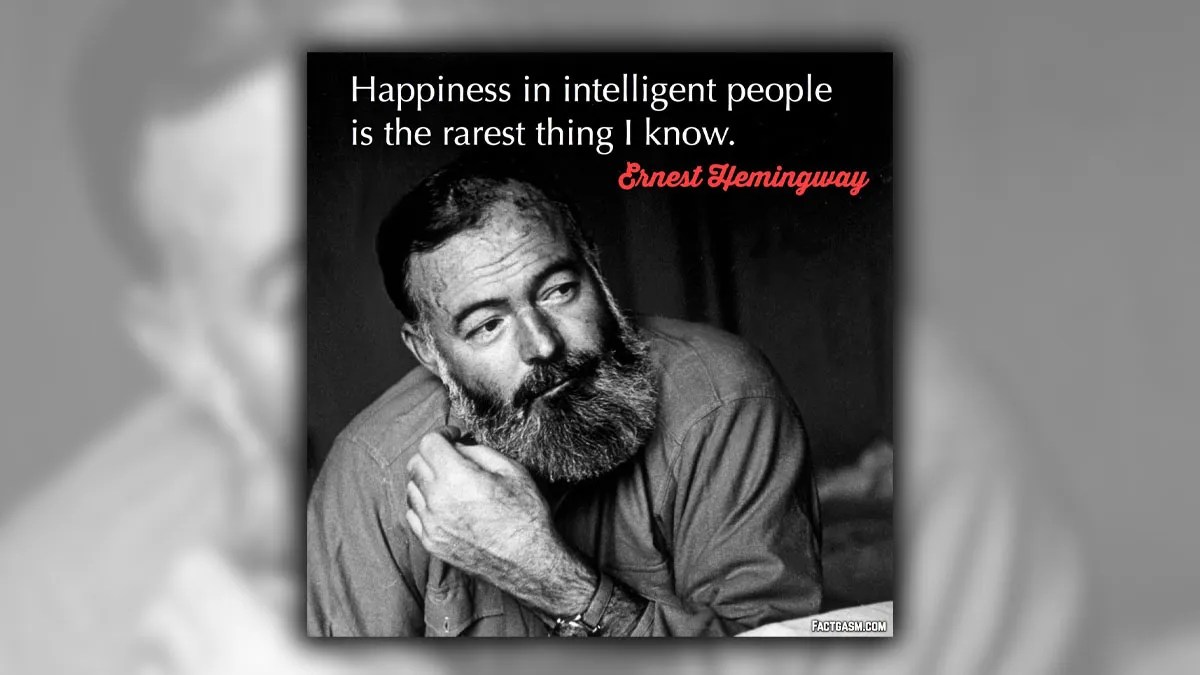
Novelist Ernest Hemingway once wrote: “Happiness in intelligent people is the rarest thing I know.”
Rating:
Context
Though Hemingway wrote the quote, it was attributed to a character in his posthumous 1986 novel, “The Garden of Eden.”
According to a rumor that has circulated online for years, novelist Ernest Hemingway once wrote: “Happiness in intelligent people is the rarest thing I know.”
For example, on Nov. 12, 2025, a TikTok user shared the quote as part of a photo post (archived) showing a piano, accompanied by German-born British composer Max Richter’s famous piece, “On the Nature of Daylight.”
Social media users shared the same quote, and in most cases Hemingway’s name, on Bluesky (archived), Facebook (archived), Instagram (archived), Pinterest (archived), Reddit (archived), Threads (archived), TikTok (archived) and X (archived). Others attributed the words to physicist Albert Einstein or author Kay Bratt.
In short, Hemingway, who died in 1961, truly authored the quote about happiness in intelligent people. Rather than being written in his own voice, however, it was attributed to a character in his posthumous 1986 novel, “The Garden of Eden.”
The quote in ‘The Garden of Eden’
The Massachusetts Institute of Technology website hosted a copy of the full novel, including the in-question quote, which appeared on Page 97 (emphasis ours):
When they were at lunch in the dining room out of the wind, David asked, “What about your friend Nina?”
“She’s gone away.”
“She was handsome,” David said.
“Yes. We had a very big fight and she went away.”
“She was a b****,” Catherine said. “But then I think almost everyone is a b****.”
“Usually they are,” the girl said. “I always hope not but they are.”
“I know plenty of women who aren’t b*****s,” David said.
“Yes. You would,” the girl said.
“Was Nina happy?” Catherine asked.
“I hope she will be happy,” the girl said. “Happiness in intelligent people is the rarest thing I know.”
“You haven’t had such a long time to find out about it.”
“If you make mistakes you find out faster,” the girl said.
“You’ve been happy all morning,” Catherine said. “We had a wonderful time.”
“You don’t need to tell me,” the girl said. “And I’m happier now than I can remember ever.”
The novel’s 1986 release
In 1986, The Commercial Appeal newspaper in Memphis, Tennessee, reported freelance writer Fredric Koeppel’s thoughts about the posthumous release of Hemingway’s novel, saying the story takes place in the south of France and in Spain and concerns “a main character who is also a writer who has just married a beautiful and wealthy woman named Catherine.”
Koeppel’s piece in the paper, excerpted below, specifically mentioned the quote about happiness:
Catherine is a little crazy, the man finds out, and when they make love she wants him to call her David and she calls him Catherine and she tells him she wants to be a boy but she wants to be his good girl too.
Catherine keeps cutting her hair shorter and shorter between episodes of swimming and sitting in the bar drinking martinis and wine and eating south-of-France type food. But David is trying to write stories about (guess where) Africa and (guess who) his father, and he feels more real in his stories than in his life with Catherine, which is getting complicated.
The beautiful woman who wants to be a boy seems jealous of her husband’s success, and she burns all his good reviews and even the stories he is working on. She picks up a girl and brings her home for both David and her to love and make love to; things get even more complicated, and the characters are alternately miffed or ecstatic and Catherine gets weirder and weirder.
It’s like “The Black Book” or “Nightwood” or that movie, “The Hunger,” with Catherine Deneuve and David Bowie and Susan Sarandon, where everyone is very beautiful and chic and sophisticated and yet their eyes are sad and they are filled with a great swelling sadness because life beyond its simply heavenly lovely days and wine and terrific food and its esthetic stuff is filled with sadness itself, and all our hopes and desires will turn to sad ashes.
People in this novel say things like “Don’t we have wonderful simple fun?” and “Remember everything is right until it’s wrong” and “Happiness in intelligent people is the rarest thing I know.” And if David says more than three sentences to Catherine he apologizes for making a speech because he mistrusts rhetoric and he must keep tightening his discipline so he won’t lose control.
For further reading, Snopes previously reported on a photo allegedly showing Hemingway and fellow author George Orwell during the Spanish Civil War. We also investigated the claim Hemingway once won a bet by crafting the six-word short story, “For Sale, Baby Shoes, Never Worn.”